Current Projects
Global Imaginaries of Generative AI
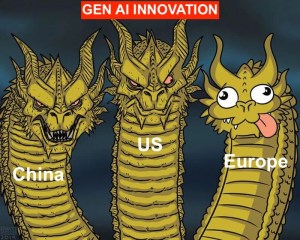
Through rhetorical analysis of news articles and Reddit-based online conversations, graduate student Sara Rabon and I argue that various social groups wrestle with Deepseek’s development and release as confronting U.S. dominant technoimperialism (Tacheva & Ramasubramanian, 2023; Novick et al., 2024), challenging the imaginary of U.S. technoliberalism (Pfister & Yang, 2018), and advancing Chinese technonationalist (Na & Pun, 2023) interests. Supporting Kawamata’s (2023) findings, our paper argues that U.S. institutional voices, represented by official U.S. companies and mainstream news sources, maintain U.S. technocapitalist dominance imaginaries, challenging DeepSeek’s purported development story and arguing the superiority of U.S. models as an extension of U.S.-Chinese technological hegemony struggles. Similarly, Chinese institutional voices, represented by state-backed news outlets, argue against this U.S. dominant narrative and in favor of expanding DeepSeek’s global reach. Vernacular voices, represented by large AI-related subreddit communities, appear more amicable, rejecting presumed U.S. superiority and instead engaging in conversation about everyday use and comparison with other models, particularly OpenAI’s ChatGPT.
Through the differing rhetorical framings of DeepSeek R1 and U.S.-based genAI models, empowered institutions and everyday hobbyists negotiate pre-existing social imaginaries within the unstable environment of cutting-edge genAI technologies. This is not to argue that DeepSeek is a superior technology to developments within the US (though this argument at times did emerge from vernacular voices). Rather, we argue that these differing rhetorical framings reveal how competing social imaginaries around emerging technologies are discursively constructed and reinforced by interacting social groups. Ultimately, while Deepseek’s development and release challenged U.S. technoimperialism on a global stage, everyday users framed the comparison of U.S.-based and Chinese-based genAI not in terms of sociopolitical relations but in terms of technological functionality and potential.
Familial Digital Archive Project
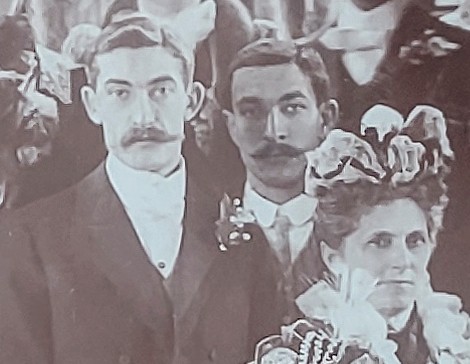
This project seriously considers how to advance digital archiving work through a new approach to archiving practice grounded in autoethnography through the digitization of a material dataset of family materials, including official documents, such as marriage certificates, and unofficial documents, such as letters sent between family members during the Vietnam War. As such, this project contributes to the fields of digital archiving, historiography, anthropology, communication, and digital production. Currently, this work is informed by and breaks from traditional views on digital archiving. The field generally considers digital archiving from two perspectives—born digital items being archived, such as in the massive internet archive project of Wayback, or traditional archives becoming digital. Little focuses on personal or family archives becoming digital. In 2011, Abigail Sellen published “Family Archiving in the Digital Age” as part of an edited book, The Connected Home: The Future of Domestic Life. While about the digitization of the family archive, Sellen was concerned with how traditionally physical artifacts, like images, were becoming increasingly digital and how that impacts the creation of the family archiving. Sellen was not concerned with the intentional act of creating a digital archive from a physical family collection. Others working at the intersection of family archives and digital archives have looked at using professional archiving services (Uotila 2014), digital family archives for education (Oksana 2021), digitizing family photo albums (Kohan-Harpaz 2021), and teaching scholarly editing through a digital family archive (Sutherland 2022), among others. Furthermore, while there is some recent work on the use of generative AI in creating and augmenting digital archives (Reyes et al. 2025, Tetteh 2025, Aliyev et al. 2026), these works rarely consider family archives and do not seriously consider the ethical parameters of creating public family archives in the current digital moment. Therefore, while informed by the work of historiographers and archivists working across both physical and digital mediums, this project is a new entry to the field of how archives operate in a generative AI digital world and a new approach to contextualizing the digital archive through autoethnography for the increased preservation of physical materials.
Ancient Egyptian Funeral Rhetoric
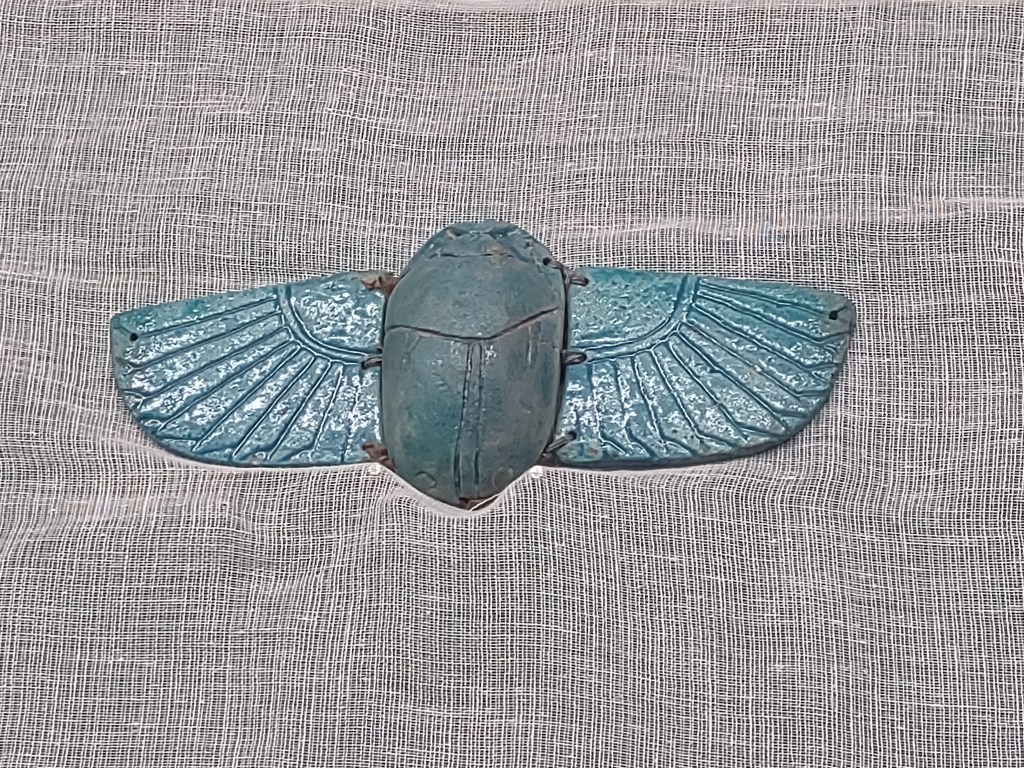
There is no such thing as ancient Egyptian rhetoric. What we conceive of as ancient Egypt covers a period of roughly 3,000 years, 31 dynasties, multiple kingdoms, intermediate periods, and times where Egypt was conquered. To put this in context, Beowulf, in written form, is approximately 1,000 years old. It is written in Old English and must be translated to be understood by contemporary audiences, and still, the cultural touchpoints in Beowulf are foreign and distant from contemporary audiences. Asking a layperson to read and understand Beowulf in its original form is like asking an Egyptian of the New Kingdom to understand Egyptians of the Middle Kingdom. Flattening all of ancient Egypt to one culture would be the same as saying there is no difference between contemporary and Bronze Age England. We can find meaning for our contemporary times from Beowulf and Bronze Age England, even some similarities, but it would be a disservice to try to say it is the same. So, too, for ancient Egypt, despite its overall highly rigid hierarchy and ritualized practice, we must consider the similarities over time while not losing sight of the uniqueness of the specific place and time we are studying. While most work on ancient Egyptian rhetoric comes from the Instructions of Ptah-hotep and Kagemni (also known as The Precepts of Kagemni), both texts purportedly from the Old Kingdom, this project considers the (primarily) New Kingdom phenomenon of the heart scarab as a source for understanding how rhetoric and persuasion operated during this later period of Egyptian history. This work complicates previous understandings of how ancient Egyptians utilized and conceptualized silence and truth in hierarchical conversations, especially when persuading from a lower status to a higher one- in this case to the highest status of all, the gods.
This work is currently being prepared for journal submission.
Marginalized Identity Play: A Book Project
In addition to the above projects, I am currently preparing a book proposal based on my dissertation in which I explore how marginalized identity play operates in the digital public sphere.

 Ailea MP